
How small decisions, repeated consistently, can create extraordinary financial capacity
Time passes for everyone. But it does not build wealth for everyone.
Consider two people who begin their working lives with similar opportunities. One starts setting aside a modest amount early, investing consistently and allowing accumulated resources to grow. The other intends to do the same but keeps postponing the decision. There is always something more immediate: a better car, a larger apartment, another expense that cannot wait.
Neither person necessarily makes one dramatic financial mistake. But after twenty or thirty years, their financial circumstances may look remarkably different. Time passed for both. Only one consistently gave time something to work with.
The Mathematics of Patience
Compounding occurs when money earns a return and those returns remain invested, creating the potential for additional earnings. Consider a hypothetical $10,000 investment earning 6% annually. After one year it becomes $10,600; after two, $11,236. The second year earns $636 rather than $600 because the earlier return also earns a return.
After twenty years, under that same fixed-return assumption, the original $10,000 would become approximately $32,071. Real returns fluctuate; investments can lose value, and taxes, fees, and inflation affect results. This illustration is not a forecast.
Why Starting Matters More Than Starting Big
Many people postpone investing because the amount available seems too small. Yet financial progress often begins with a repeatable habit. At a hypothetical 6% annual return compounded monthly, investing $200 each month for thirty years would accumulate to approximately $201,000. Contributions total $72,000; the balance represents hypothetical growth.
Not everyone can spare $200 a month. For some households, even $20 requires planning. The principle is to begin at a sustainable level and give time something to work with.
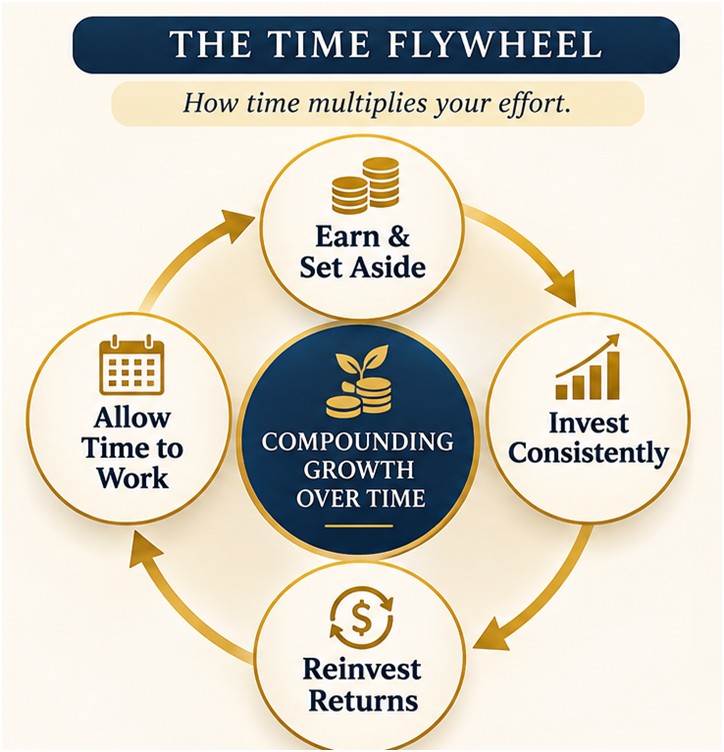
The Time Flywheel · Ideas Worth Carrying
The Other Side of Compounding
Compounding can also work against us. Interest added to unpaid high-interest debt can increase what we owe. Recurring commitments can absorb future income. The same passage of time that strengthens financial independence can deepen dependence when the underlying habits point in the wrong direction.
Four Ways to Put Time to Work
- Begin with what is sustainable. Choose an amount that fits your circumstances without putting essential expenses at risk.
- Automate the process. Arrange regular transfers to appropriate savings or investment accounts.
- Match investments to the timeline. Money needed soon generally calls for stability and accessibility; longer horizons may permit more fluctuation, depending on risk tolerance.
Review without constantly changing direction. Periodically assess contributions, costs, diversification, and goals rather than reacting to every market movement.
A Question Worth Carrying
Twenty years will pass whether we prepare for them or not. What will those years leave behind—more obligations and dependence, or greater ownership, resilience, and freedom?
Start where you are. Build what you can. Give time something worthwhile to multiply.
Inspired by From Work to Wealth: Building a Life of Margin, Ownership, and Freedom — Pat Anyaegbunam.
Educational content only; not individualized financial or investment advice.