
Moving from earning a living to building lasting financial capacity
There is a difference between earning money and owning something that can continue creating value.
Consider a skilled professional with a comfortable income. Each month, money arrives, bills are paid, and family obligations are met. But if the income stopped, how long could the household maintain its essential commitments—six months, three months, or two weeks?
The answer reveals something important. A good income can support a comfortable lifestyle without necessarily creating financial independence. This is why ownership matters.
What Changes When We Own?
Through work we exchange time, knowledge, skill, or effort for compensation. There is dignity in that exchange. But most employment income depends on continued participation. Ownership introduces another possibility: resources that may retain value, appreciate, generate income, or reduce future obligations.
A diversified portfolio, retirement assets, equity in a business, or a financially sustainable rental property can contribute to that capacity. Not every asset produces income; not every investment appreciates. Ownership carries risks, costs, and responsibilities.
Ownership Is Not the Same as Possession
We own furniture, vehicles, electronics, and other useful possessions. They can improve life, but many primarily provide consumption or convenience rather than future economic value. A car may be essential for getting to work while also depreciating and requiring maintenance. An investment may fluctuate but offer long-term growth potential.
Neither category is inherently good or bad. The question is what role each plays in our financial structure. A household needs useful possessions—and resources capable of supporting future choices.
The Ownership Flywheel
Productive work creates income. Disciplined decisions preserve a portion. Preserved resources can be used to acquire assets. Assets may grow or generate income, and some proceeds can be reinvested. Over time, that reinforcing cycle can strengthen financial capacity and expand choice.
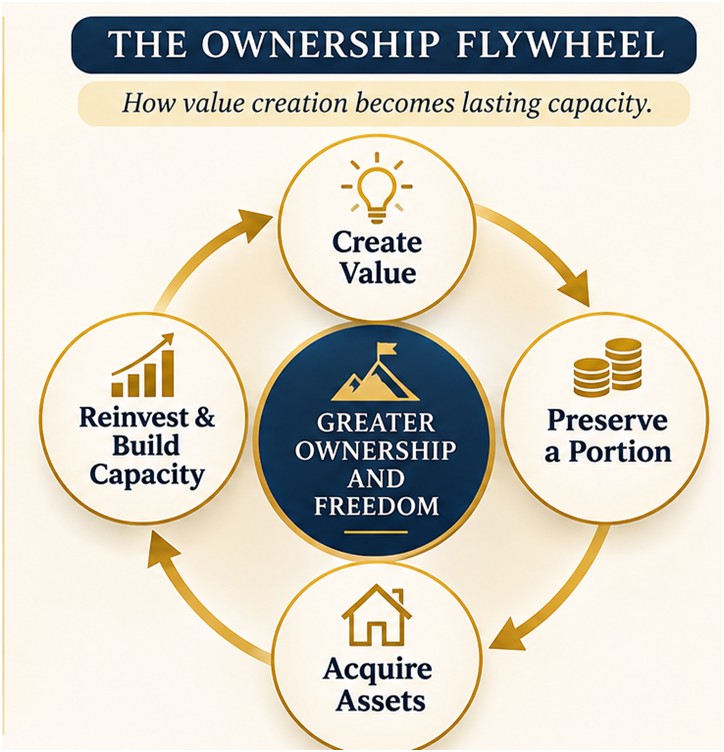
The Ownership Flywheel · Ideas Worth Carrying
Five Steps Toward Greater Ownership
- Examine where money goes. Separate immediate consumption, debt repayment, savings, and ownership-building investments.
- Reduce expensive obligations. High-interest debt can absorb money that might otherwise strengthen your position.
- Accumulate appropriate assets. Consider retirement accounts, diversified investments, or other assets suited to your goals and circumstances.
- Reinvest thoughtfully. When assets generate proceeds, consider whether reinvestment supports your long-term objectives.
- Measure the freedom created. Ask whether your structure can better withstand setbacks and support meaningful life choices.
The Freedom Test
Suppose a job offers more pay but substantially less time with family. Could you decline? Suppose you wanted to return to school, care for a parent, or start a business. Could your accumulated resources help you navigate that transition?
Ownership does not guarantee every choice. It can, however, gradually expand the choices available—and that is why wealth building deserves attention beyond the balance sheet.
A Question Worth Carrying
Every working year gives us a chance to create value. How much of it becomes ownership? How much strengthens resilience? How much reduces dependence on the next paycheck?
Work is valuable. Ownership can make its fruits more durable. And that durability can become a foundation of freedom.
Inspired by From Work to Wealth: Building a Life of Margin, Ownership, and Freedom — Pat Anyaegbunam.
Educational content only; not individualized financial or investment advice.